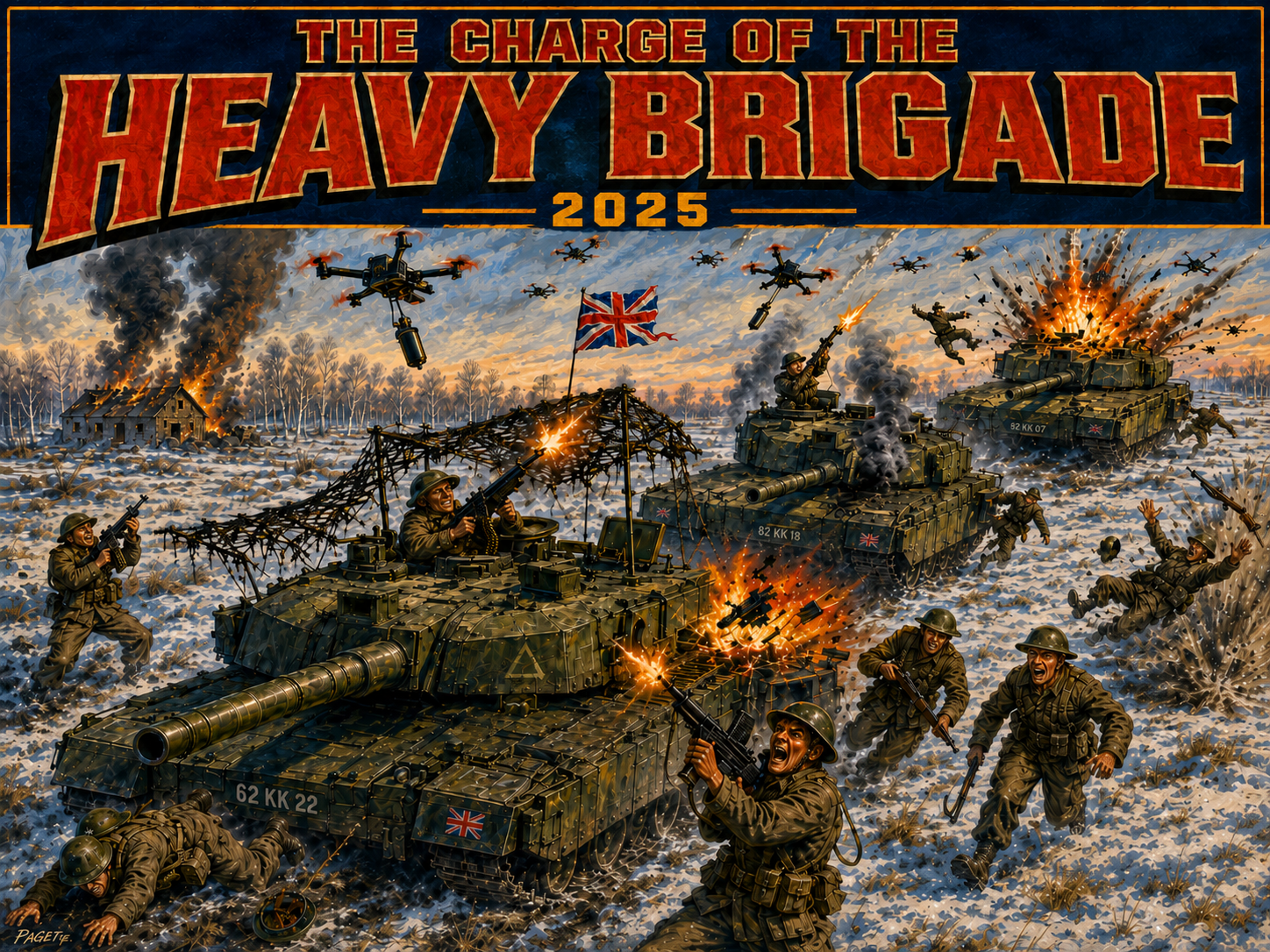
Evolving
The MBT
Heavy armor endures. The fight moved upstream of the gun.
History Lesson:
When the fight
moved outside
gun range.
Before guessing what the tank becomes, look at the last weapon that defined a domain. The battleship set the standard for naval power for decades. Between 1940 and 1945, aircraft made range, scouting, and target assignment more decisive than armor belt or gun caliber.
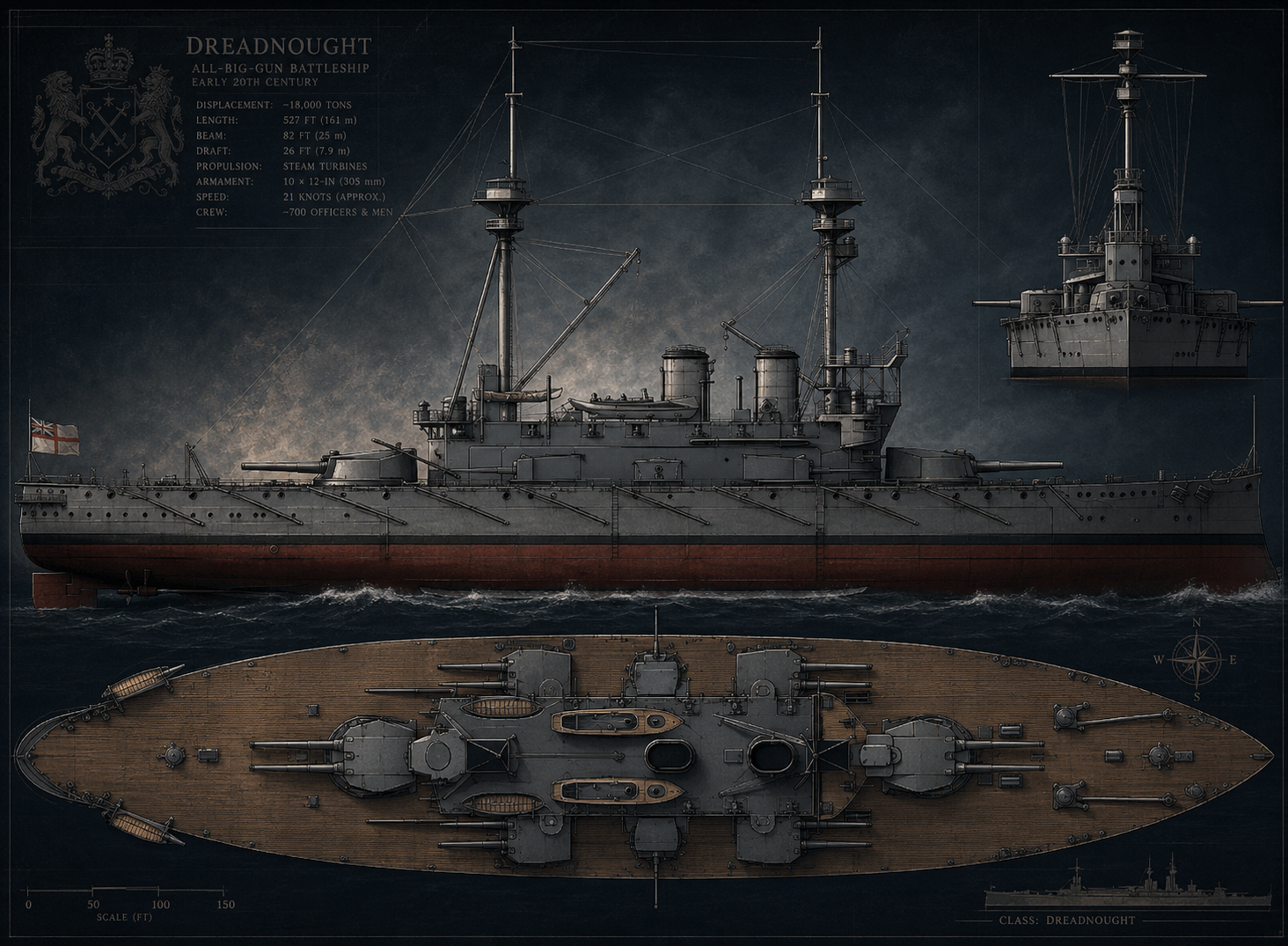
HMS Dreadnought
Admiral Jacky Fisher pushed through a battleship radical enough to name a class. Ten 12-inch guns in five turrets where earlier battleships carried four. Steam turbines replacing reciprocating engines. 21 knots, fast for anything her size. Built in a year and a day as propaganda as much as engineering.
At commissioning, every older battleship became "pre-dreadnought." She reset the capital-ship benchmark in a single afternoon.
- Main guns 10 × 12-in
- Displacement ~18,400 t
- Top speed 21 kn
- Propulsion steam turbine
- Built in 1 yr 1 d
The capital ship
doctrine
For three and a half decades the dreadnought was the unit of naval power. Nations were ranked by tonnage. The Anglo-German naval race was a dreadnought-counting race. Treaties at Washington (1922) and London (1930) tried to cap the competition.
The logic was Mahanian: control the sea through decisive surface battle. Big guns reached farther. Armor scaled to match them. The whole ship became a gun platform with a city's worth of steel wrapped around it.
- Doctrine decisive battle
- Reach ~30–42 km
- Armor belt up to 410 mm
- Crew ~1,500–2,700
- Symbol of national power
Jutland (1916) was the only fleet-on-fleet dreadnought engagement of the First World War, and it was inconclusive. The biggest ships, fighting the battle doctrine expected, produced a result no one could quite call decisive. Interwar navies kept building battleships anyway, while officers in the US, Japan, and Britain worked on aircraft carriers as a side project with strategic consequences.
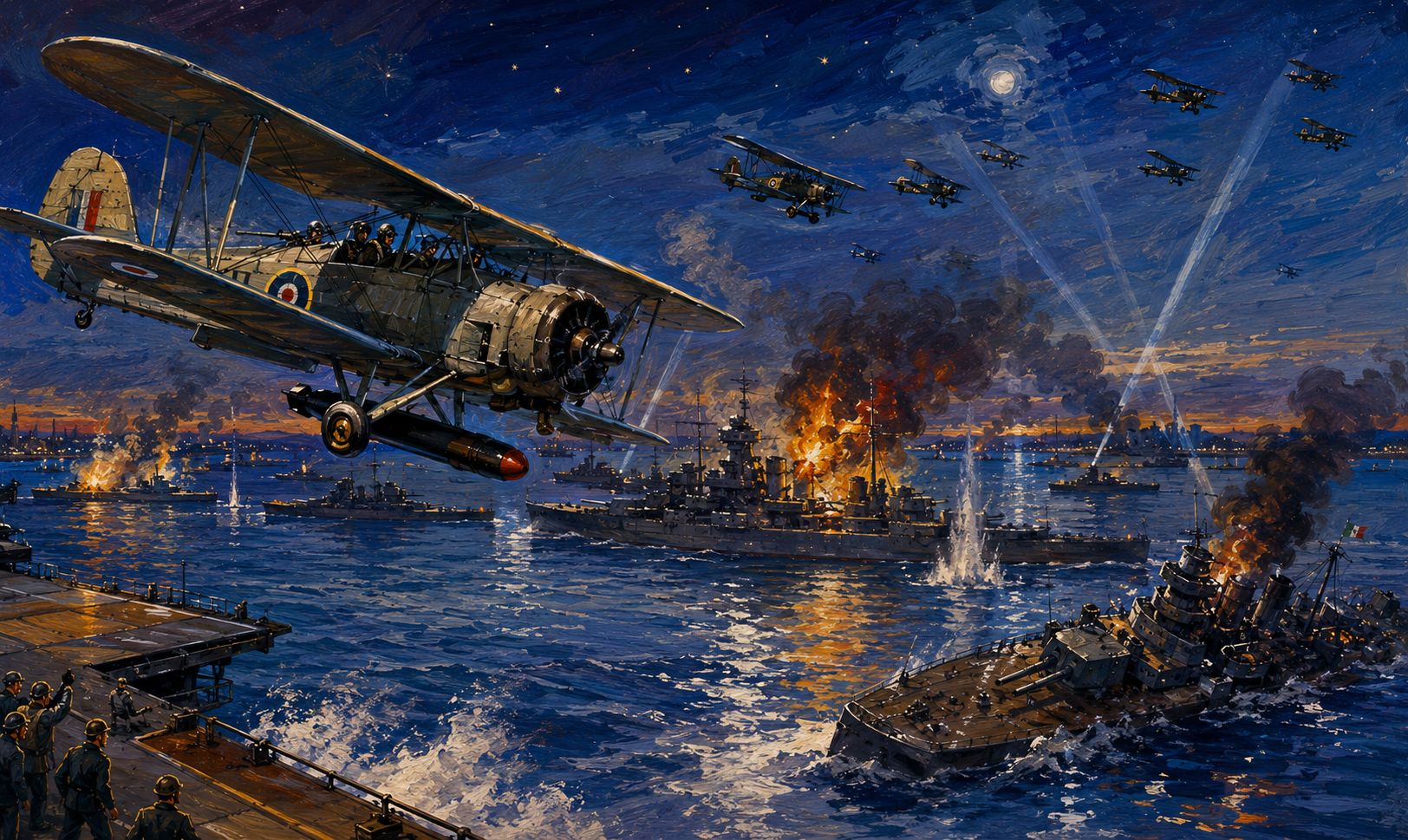
Between Taranto in 1940 and Yamato in 1945, combat moved the capital ship out of the center.
How the era
came to a close
Gun range
versus flight hours.
Battleship reach
main gun, max elevation
(Yamato 18.1″)
covered
Carrier air-wing reach
strike radius, WWII naval aviation
(WWII air wing)
covered
Both diagrams are drawn at the same scale. The carrier's air wing reaches roughly eight times farther than the battleship's biggest gun and covers something like seventy times the area. The battleship lost when the geometry of the fight stopped fitting inside the circle its guns could draw.
A dominant platform was displaced by a system that pushed decision outside its weapon range: scouts, aircraft, carriers, and radios. The land version is the reconnaissance-strike system around the tank: finders, assigners, cheap shooters, and a target record that can become lethal before the tank sees anything.
The old model
was a dreadnought
on tracks.
Armor, gun, mobility, direct-fire dominance. The tank exists to close with the enemy, survive hits, and kill what it can see.
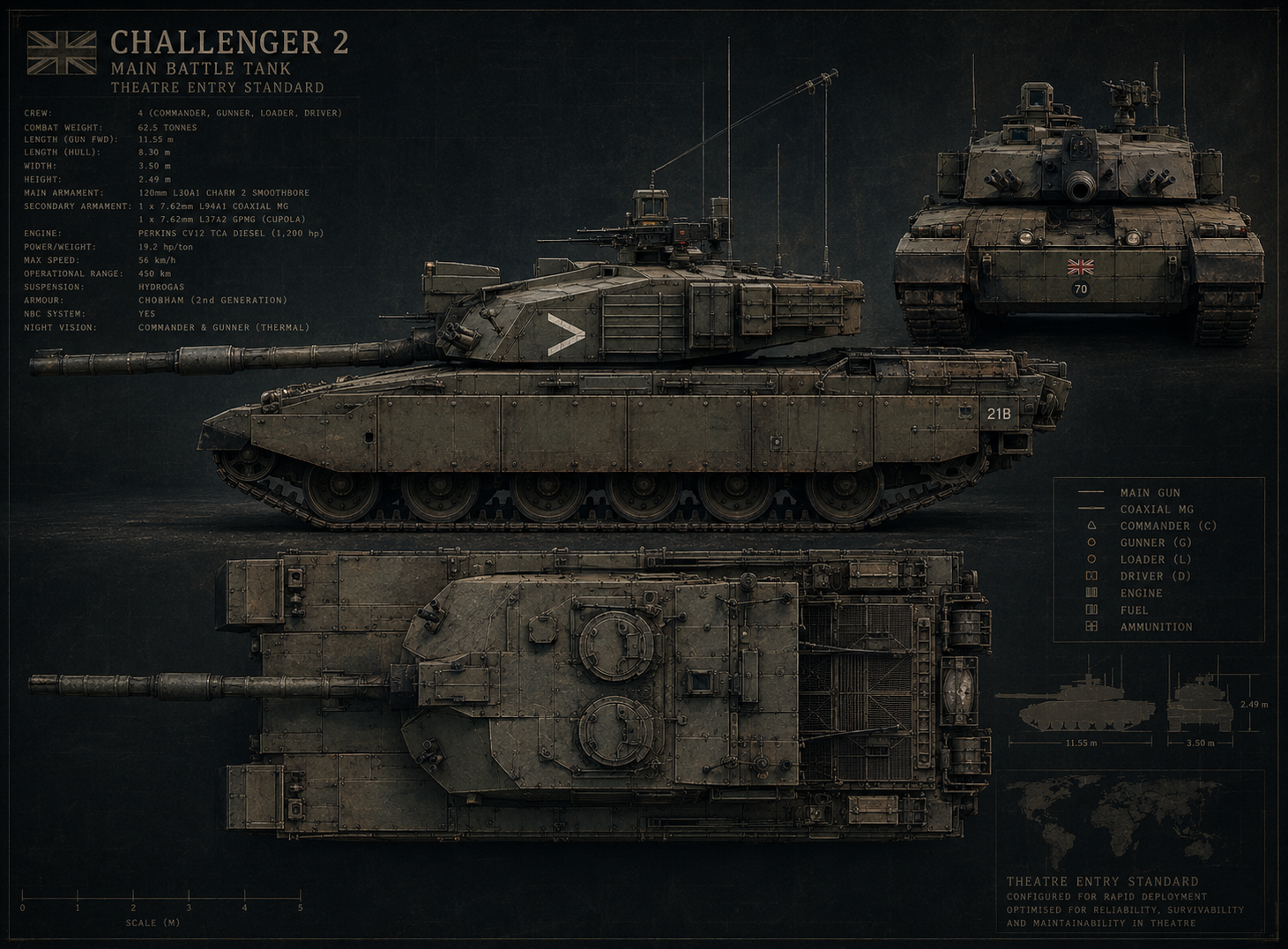
The job remains. Someone has to enter the killing ground, push through rubble, protect infantry, breach, shoot through walls, and hold ugly ground. Drones do that job badly.
The drone-era tank lives inside a larger target picture. The center of gravity shifts toward the formation, custody, and how long the vehicle can stay off the enemy's board.
Drone-era armor dies when it gets found and processed.
The tank enters
a custody chain.
Found by a scout drone. Confirmed by another sensor. Marked in a chat. Watched by an operator. Assigned to FPV, artillery, Lancet, mine, glide bomb, or another shooter. Hit. Re-hit. Filmed. Logged. Shared.
This is the cold part. The armored group has to attack the chain before the shooter arrives: blind the scout, stale the coordinates, jam the link, kill the operator, flood the record with decoys.
The custody chain
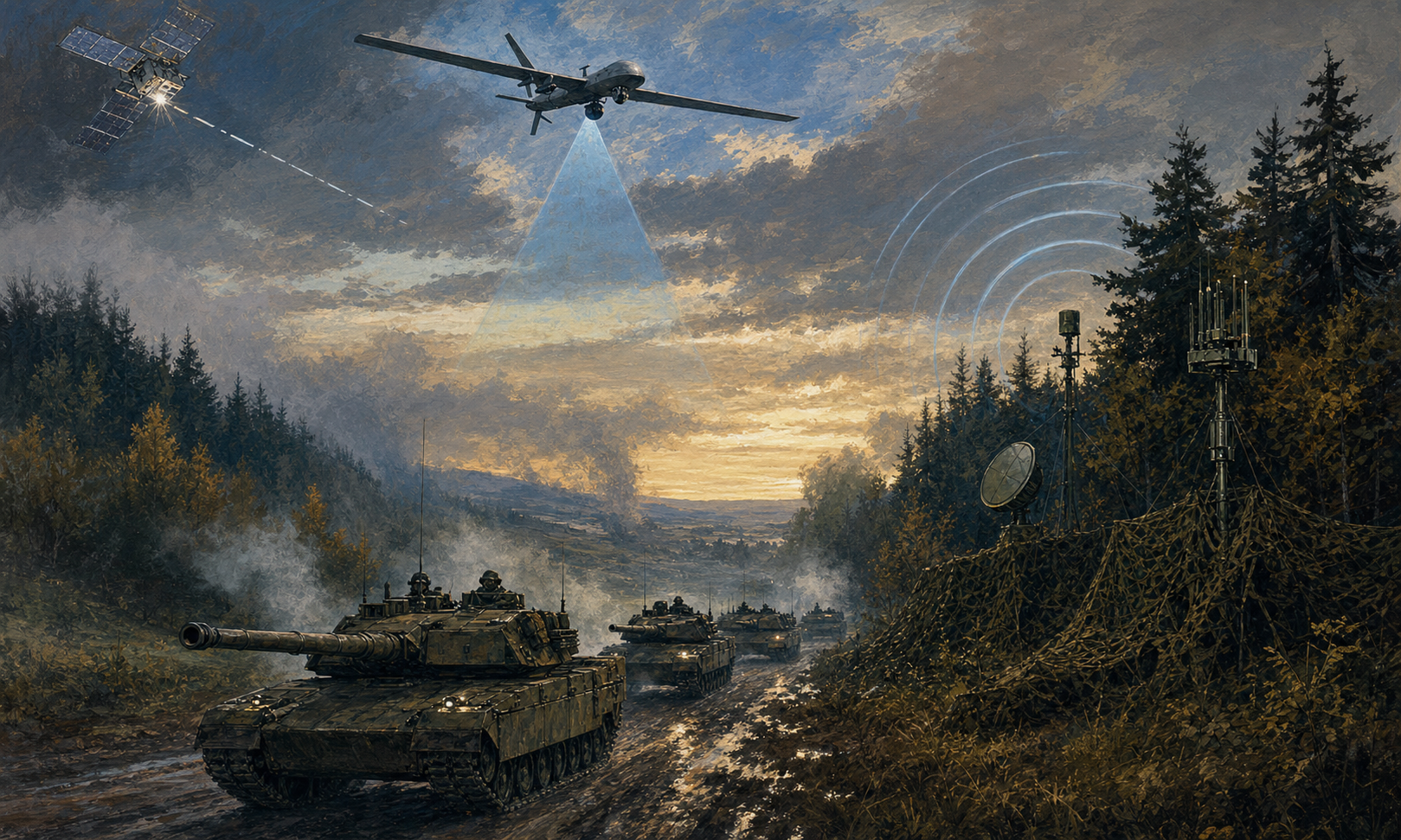
The formation has to break custody before the shooter acts: hide, jam, spoof, decoy, emit less, kill the operator. Make the enemy's target record stale before it becomes a strike.
The land
carrier group.
The plausible 2050 armored package is a carrier battle group compressed onto land: distributed magazines, specialized escorts, and a protected close-contact core.

Compact armored
battle group
- THeavy crewed tanks2–4
- UCVUnmanned gun / missile wingmen2–6
- C-UASCounter-drone turret vehicle1–2
- EWElectronic warfare / spoofer1
- DRNDrone magazine carrier1–2
- BRCHRobotic mine / obstacle breacher1–3
- INFMounted infantry + engineers2 sct
- DECDecoy emitters / dummies∞
- RLDReload / repair vehicles (1–3 bounds back)2+
- FIRELinked artillery, mortars, ADnet
The tank is the protected close-contact tool. The group around it exists to get that tool to the point where direct fire can still decide the local fight. The question becomes blunt: can the formation avoid being found, tracked, assigned, struck, and re-struck before it does useful work?
The tank itself may carry a ready rack of drones: a few scouts, a few FPVs, a few interceptors, a fiber-optic drone or two, and some pop-up relay capacity. The deeper magazine sits in trailers, robotic mules, or support vehicles behind it. Ready drones on the tank; volume behind it. A tank carrying hundreds of exposed drones becomes a bomb with tracks.
Dreadnought
on tracks
One protected vehicle. Measured in mm of armor and mm of bore.
- Armor depth RHA mm
- Main gun bore mm
- Sprint speed km/h
- First-round hit %
Carrier group
compressed onto land
Protected close-contact force inside a moving battle group. Measured in sortie rate, custody, and signature.
- Drone sortie / hour UAS·h⁻¹
- EW endurance min
- C-UAS magazine rounds
- Reload cycle min
Sortie generation
becomes a tank metric.
Armor, gun, and speed remain on the scorecard. The custody contest adds measurements that decide whether the formation survives long enough to move.
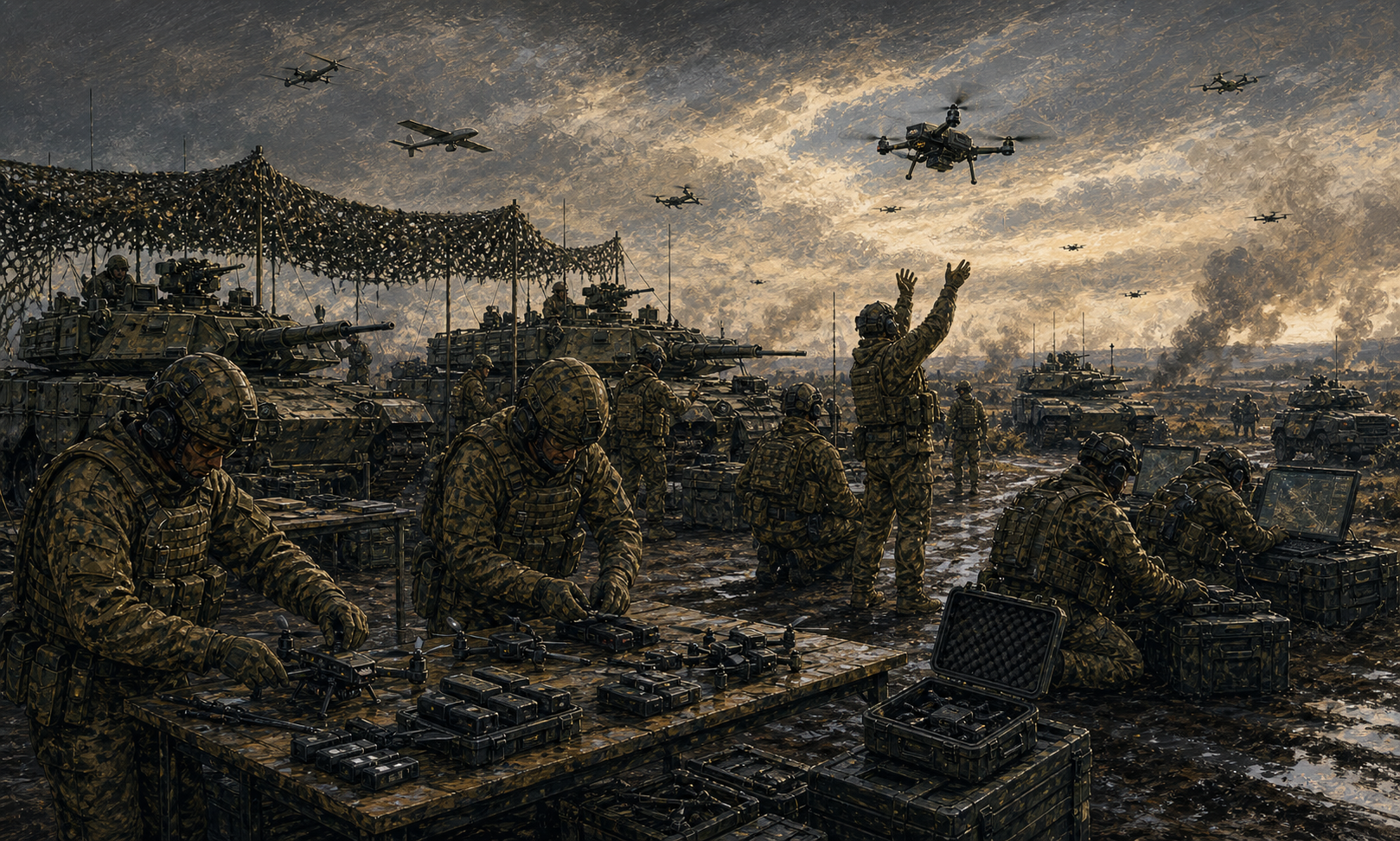
The most valuable
zone is the last
1–5 km.
Long-range ISR and fires are essential. They have latency, priority fights, bandwidth limits, and command friction. A tank crew approaching a tree line, ruined village, bridge, or ditch needs answers in minutes — sometimes seconds.
Local drones give immediate sight, immediate battle damage assessment, immediate decoys, immediate counter-drone reaction, and immediate route checks. Long-range sensors see patterns at distance; local drones see the tree line, the ditch, the ambush.
This is also where the tank's gun still earns its keep. Drones scout, bait, mark, and strike. The gun does immediate heavy work: wall, bunker, vehicle, treeline, breach point. Scout, jam, decoy, strike, suppress, breach, push, clear, hold — usually with drones forward, the tank in the middle, and infantry last.
Hardening
in six layers.
No single layer protects a vehicle from a modern reconnaissance-strike pipeline. Each layer breaks a different step in the kill chain. Skip one and the others get bypassed.
Before walking the layers, look at the problem they're solving. A vehicle in marching order is loud on every axis a sensor can read: thermal, acoustic, RF, visual, dust, magnetic, ground vibration. Hardening pulls each trace inward toward the center of the chart. The gap between the two polygons below is the job.

Physical hardening
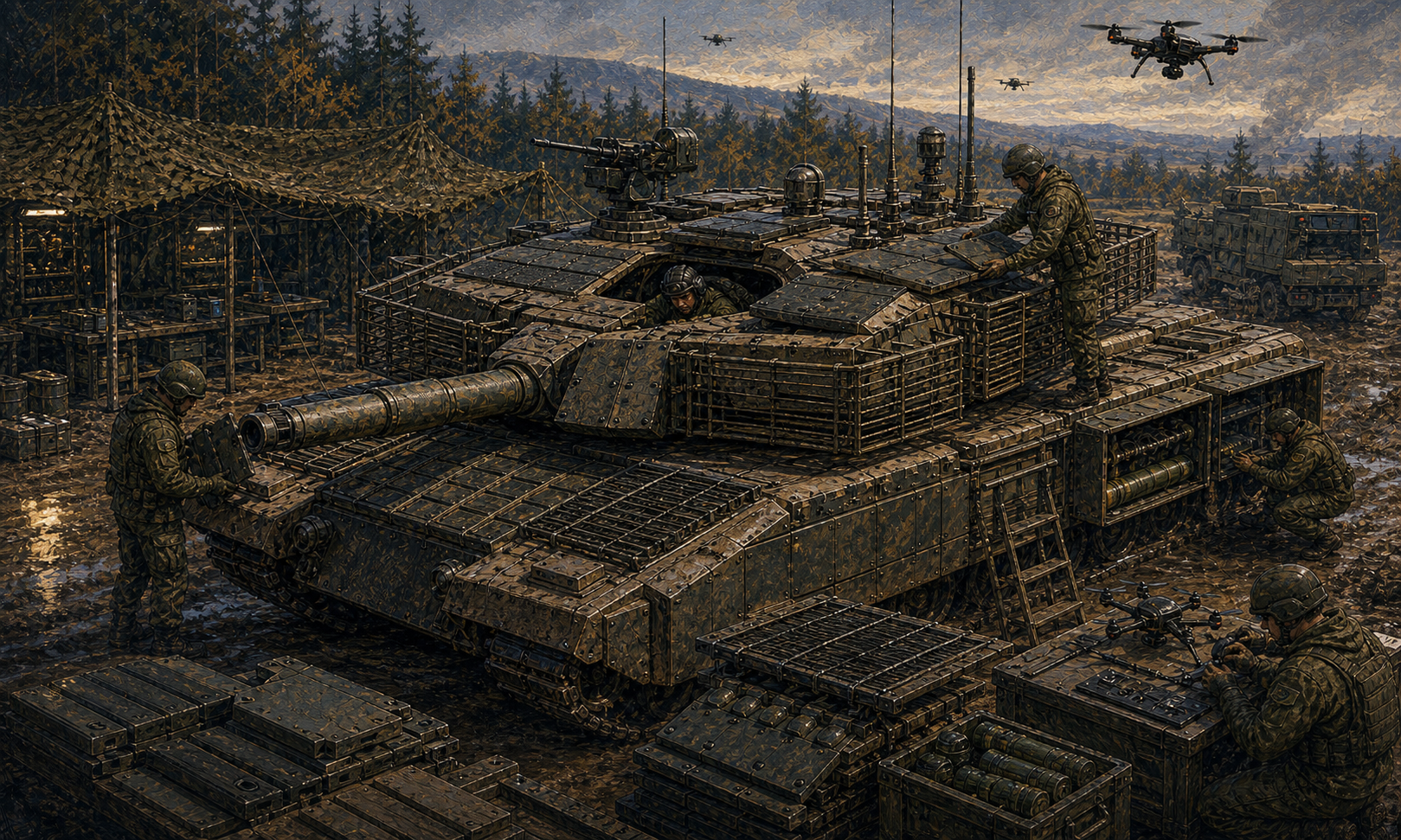
Roof protection, modular overhead armor, factory-designed cage kits, protected engine decks, separated ammo and drone cells, thermal management, signature masking, crew capsule design. Vents, exhaust, antennas, and repeated heat patterns now matter.
Soft-kill hardening
Jammers, spoofers, decoys, smoke, dazzlers, false RF emitters, false thermal signatures, and signature discipline. Make the enemy see too much, too late, or too ambiguously. The goal is to corrupt the target record before a shooter is assigned.
Hard-kill hardening
APS against missiles and top-attack munitions, mini-CIWS style turrets, airburst rounds, shotgun-like local defenses, lasers where power and weather allow, and cheap interceptor drones. The last few hundred meters around the tank have to become dangerous for enemy FPVs.
Network hardening
Short emissions, directional comms, frequency agility, fiber options, line-of-sight relays, autonomous fallback, and local data discipline. Spectrum becomes terrain. Casual emissions get you killed.
Operational hardening
Dispersion, movement by bounds, route deception, overhead concealment, drone screens, operator protection, rapid displacement, decoy traffic, preplanned hide sites. Static prestige kills the group. It has to pulse: launch, sense, strike, move, hide, reload.
Training hardening
Every exercise needs hostile drones. Drone-sterile training teaches false habits: parking wrong, emitting wrong, bunching wrong, moving too slowly, and waiting for clean command channels.
The bear case
is ugly.
A squadron of 10 land carriers driving forward in a neat package gets seen from space, heard on spectrum, watched by drones, delayed by mines, bracketed by artillery, then swarmed by FPVs and loitering munitions.
At sea, the carrier buys depth and distance. Land gives less of both, plus far more clutter.
Land is meaner. No clean horizon. No open ocean. Mines, basements, trees, wires, mud, civilians, trenches, culverts, rubble, thermal clutter, and cheap observers everywhere.
- Support trailers are soft. They die early.
- Antennas are loud. RF betrays the formation before the tanks fire.
- The route is predictable. Maps and overhead imagery narrow it for the enemy.
- The drone magazine becomes a liability — one good hit cooks a whole platoon's air wing.
- One immobilized vehicle creates a traffic problem. Traffic problems create target sets.
- Operators are concentrated. Take them out and the air layer goes dark.
- Reload cycles get caught between bounds — gaps in coverage, gaps in suppression.
- The super-tank version is too concentrated, too proud, too easy to detect, too much magazine on one hull.
Creating
a window.
Drones strengthen defense by making movement visible and punishable. Mines, artillery, FPVs, EW, and loitering munitions make visible movement expensive fast.
The carrier-style armored group has to manufacture short windows where the enemy picture is wrong enough to move through. If it can reliably create 600 meters of movement, then another 600, then another, it has something. Fail that rhythm and the formation turns into expensive artillery with tracks. The sequence:
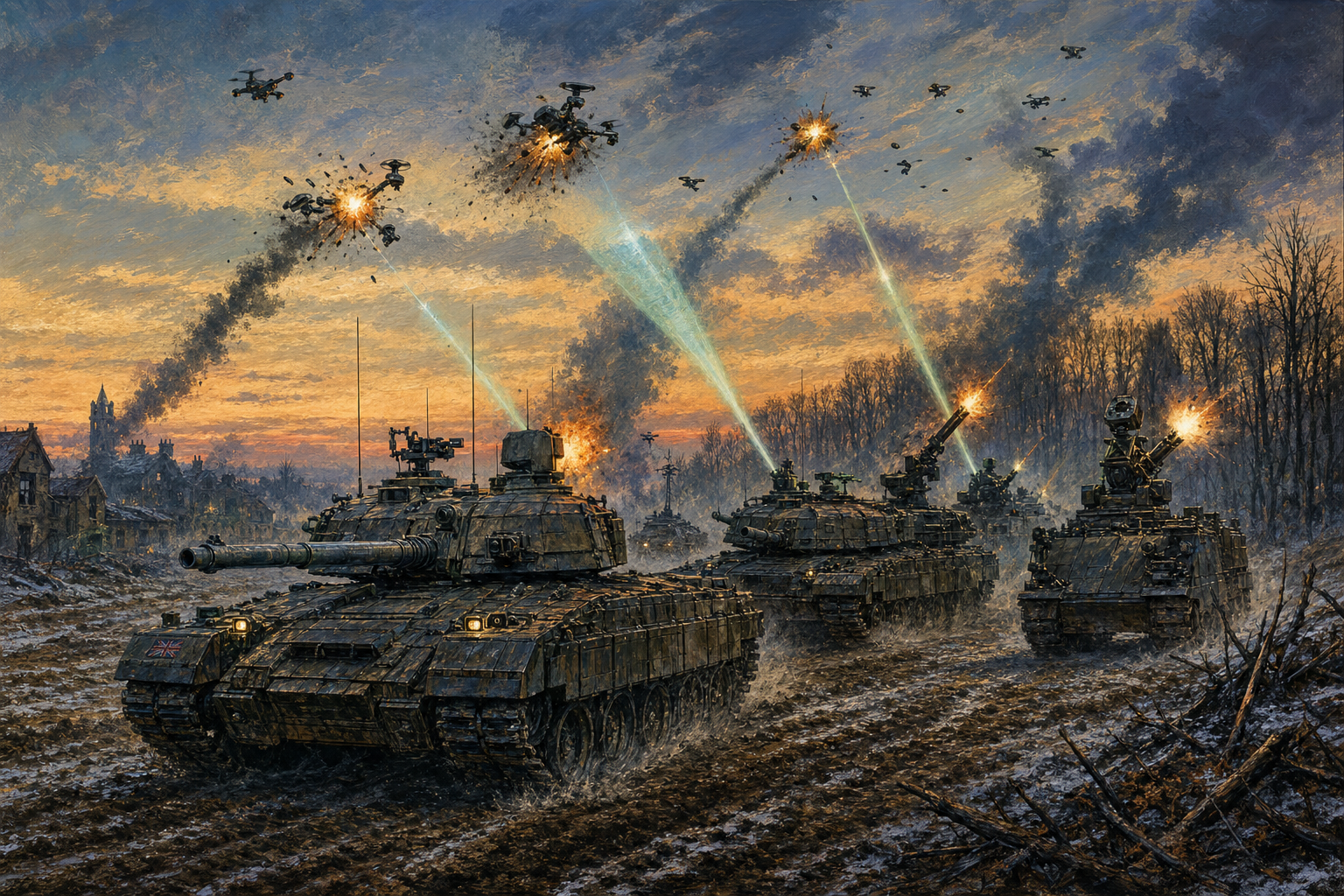

Small windows may be the whole game. The goal is enough local confusion to move — and to keep moving before the enemy rebuilds custody on the formation.
Toward a family
of vehicles.
Putting the air, spectrum, and replacement layers on one very large vehicle concentrates too much value on one hull and too much work on one crew. The stronger form is a family of vehicles designed to fight as a system, with components lost and replaced on a normal cycle.
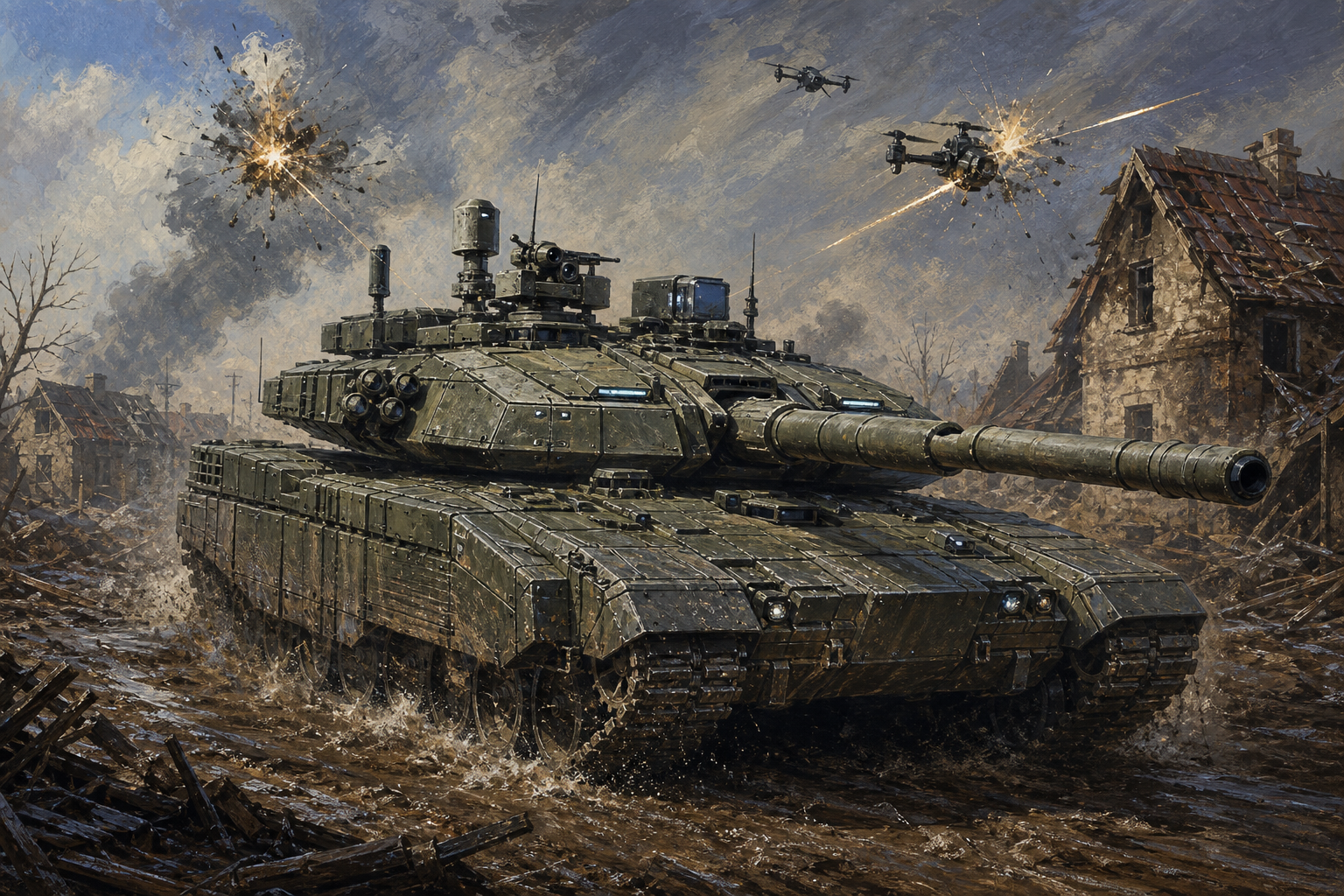
The family keeps the tank close to the job it still does best: take a hit, force contact, and turn a temporary local advantage into ground held.
What
exists already.
The ingredients are already visible. Hardware, doctrine, and field improvisation are moving toward the same shape.
PERCH
Puts Switchblade loitering munitions on Abrams- and Stryker-type vehicles, giving armor organic beyond-line-of-sight reconnaissance and strike. This is the early form of the onboard drone rack.
Bullfrog-class
counter-drone turrets
Vehicle-level mini-CIWS pointing toward a hard-kill local air defense bubble. A first step toward making the immediate airspace around armor dangerous for enemy FPVs.
M1E3 Abrams
Points toward lighter weight, hybrid power, open systems architecture, robotic teaming, lower signature, APS, and easier C-UAS integration. A legacy tank line moving toward the carrier-era feature set.
Field Artillery
writing
Loitering munitions at company and battalion level, with dedicated rearming and recharging teams. The replacement loop entering doctrine and field practice together.
RUSI · The useful caution
Drones should sit inside traditional firepower, the way escorts and missiles sit inside carrier operations. The useful caution: a land group still needs artillery, armor, engineers, air defense, and logistics.
The Midway analogy
Some Army writing now frames drone-enabled precision strike in Midway terms: a shift from direct-fire armored combat toward battles decided by scouting, assignment, and reach.
What the tank
becomes.
The 2050 armored force will be visibly more complicated: roof armour, active protection, launch cells, decoys, EW, drone racks, software, power management, reload vehicles, more operators, more maintenance.
The passing mark is the bound. Can the group keep the enemy's target picture stale while making its own picture fresh enough to act? Can it reload before the next wave, hide before the next look, and still put heavy direct fire on a wall, bunker, vehicle, or treeline when the window opens?
Custody, signature, sortie rate, counter-drone depth, reload rhythm: these decide whether a few minutes of confusion become ground taken. Armor, gun, mobility, and crew still count inside that harsher test.
